Wednesday, September 5, 2018

First Day of Calculus

In two days, I begin my 36th year teaching, and probably my 25th year teaching AP calculus.  So of course, I figured I'd try something different.

Usually I've tried to give the course some context -- we're going to find slope at a point and area under a curve:  here's why we care.  Last year, I built a  given-the-velocity-find-the-distance activity.  It was okay, and I'll probably use a revised version of it at some point in the year.  (I've already videoed the speedometer on my new e-bike in preparation.) 

This year, I'm going to jump right into limits.  Here's may plan for the first two days or so.

Day 1 (30 minutes):  First thing, a Which One Doesn't Belong (word doc link):

Since most (all?) of the students will not have done a WODB before, I suspect that (D) will be the overwhelming selection as the "right" answer.  I'll need to use my sneaky teacher skills to get them to start looking elsewhere as well.  No sweat.

Next, we'll do a Desmos Polygraph I made that will (I hope!) force them to start reaching for vocabulary they don't yet have.  ("Teach us the right words!" they'll demand, "Teach us!  Pleeeeeeease!")  

That will likely finish the 30 minutes.  It will feel half-done, but that's okay.  

For homework, inspired by CalcDave's 8-year-old* (!) blog post, discovered via Sam Shah's also 8-year-old blog post, I've made a questionnaire of my own.  I added a little more algebra to mine, and a little less get-to-know-you.  (I've taught the majority of my students before, and I know most of the rest from other things.)  I do need to test their mettle, so to speak, as I'd like to determine whether the AP pace and demands will work for them moving forward.  

Day 2 will be a couple of Speed Dating exercises.  We'll do the first one without hardly any guidance from me as to what a limit is.  I will tell them how to read the statement ("the limit as x approaches 2 of f(x)") and make that part of the exercise, so that they get used to the language.  Other than that, the'll need to figure out where the right answers come from.  This is what I've taken from the #MTBoS philosophy:  don't tell students anything.  

After that's run its course, we'll regroup as a class and I'll answer any questions they have.  Once that happens, we'll do the second speed dating exercise, this time (if all goes right) with a bit more comfort and success.  Homework will be practicing limits by graphing, and then we can get into algebraic limits on day three.

And we're off..

*As a side-note, I keep waiting for a time when I don't look back 8 or 10 years and think, "Holy cow -- I had no idea what I was doing back then."  So I'm assuming Sam and Dave have moved on to something that they feel is progress, while progress for me is moving into someone else's past.  My past is open for occupancy.  If only I'd blogged back then.


Sunday, August 5, 2018

Twitter Before Breakfast

I'd like to say that Twitter has become a daily presence in my life.  But it's much worse than that.  Okay, that's society talking.  I think it's better.  Here's what Twitter had me thinking about this morning - a Sunday morning in the summer --  from 8:03 to 8:21.

8:03.  A tweet from Amie Albrecht, now the Australian who inserts her presence in my day more than any other, as she has now surpassed Courtney Barnett.  

I always gave this exact answer when I was a kid and people asked why I liked math.  As I've continued to grow and learn, I realize that math is all about the journey and less about the destination, but I do find it comforting that there is a "truth" at the end that we can all agree on, even if that truth is that the truth is unknowable.  I can prove that root 2 is irrational, I can demonstrate that infinite sets have different cardinalities, I can prove the Pythagoream 40 different ways.  (Don't challenge me on that last one.)  Proofs are sometimes sensible, sometimes highly counter-intuitive, and sometimes incomprehensible to me (see: Fermat).  Yet, without a "right" answer at the end, the whole beautiful exercise could end in murky conclusions like a debate in economics or even science.  Those debates are obviously important, but I enjoy the comfort of knowing that an absolute (albeit abstract) truth exists out there.

There's a good discussion in this tweet's thread.

8:06.  Another one from Amie.  I was planning to do the Quarter the Cross exercise on the first day of geometry, and here's Amie adding another dimension - a card sort!  Check it out.  Thanks, Amie!
8:08.  Again from Amie.  (Not really a surprise -- she's tweeting while we're all sleeping.)  It's really a link to Fawn Nguyen's blog post about using different colored highlighters to mark student work.  I've seen this before and liked it, so I added it to a Wakelet folder (probably for the third time.)


8:09.  Andre Sasser asks about getting permission from students to post their photos.  I've been wondering about this, and also how to blog honestly about the specifics of what's happening in a classroom without running the risk of embarrassing my students should they read what I've written. I'll always try to make sure I'm communicating fondness and positivity toward my students, but I can't control how they interpret what I've written.

8:11.  I don't follow this account, but it shows up via likes every so often and I like it.  I like how the post begins:  "I pet Sadie."  I picture the build-up to this like the lunar module landing on the moon:  "I am approaching Sadie.  All systems are go. 10 feet.  Tail is wagging. 5 feet.  Tongue is drooling.  Houston, we have contact."


8:12.  Math photo scale week.  I am reminded of my candy loving (now 23-year-old) daughter, thinking I'd be almost certain to take this same photo when she were younger.  I had also seen one of these crazy machines at the movie theater last night, so I was thinking about my daughter and candy.  
Also, I want to take some #MathPhoto18 pics, but I keep forgetting to check the theme.


8:14.  Somebody saw "GOD" in a sliced eggplant.  Good ol' Twitter.


8:15.  Back to Andre with a grocery bag suggestion.

This had more meaning to me that I expected.  For the past three years, we've had two girls from Ghana at Millbrook, one of whom has lived with us.  They were back in Ghana this summer for the first time in three years, and they return this very day.  I'll be glad to see them, in part because they are literally my supermarket adventure partners.   Here's what it's like to shop with them:

I guess I gotta buy that shopping bag.

8:17.  A reminder about EquatIO.  I haven't really figured out how this will work for me, but it's on my list to look into this summer.  Getting late, though.


Then, in yet another fortuitous coincidence, when I went to log on to my computer to write this, Windows had a message for me:

EquaIO wants to "Read and change all your data on the websites I visit."  Uh, no.  I don't even give myself permission to do that.  I'll check on it later...
[Note:  I checked it out, Accepted Permissions and I'm really excited to use EquatiO this year.]

8:21.  A retweet from Blank Panther Girl.


I've been thinking about this a lot this summer, without reaching any coherent chain of thought.  It began with our trip to Ghana, where we met wonderful people and saw a country that had robbed of its resources, both physical and human, for hundreds of years before this century, largely to the benefit of people like me.  We got to meet our two Ghanaian girls' families, which was emotional beyond explanation.  The students who were with us worked with a school on some math, some storytelling and some soccer.  I know the school appreciated what we did, but it's hard to know how to feel.  This photo below of the class playing SET sums it up -- it makes me proud, confused, sad and happy all at once.  


Marian Dingle's keynote at TMC18 (watch, read) gave me further reason to reflect and even less clarity (in a good way!).  I also thought about my experience with our two Ghana girls, and how it's offered me the opportunity (if that's the right word) to see the pervasive, yet often very subtle, nature of the racism that exists in my world.  

And that's a heavy note to end on, but that's about 20 minutes of my Twitter experience.  In the middle of the summer.  All before breakfast.


Thursday, July 26, 2018

I'm Just Like Them!

I've had the experience of meeting in person people I'd admired from afar, and almost always my response has been, "Hey!  They're just like me!"  My experience last week was even better.  After meeting all the amazing people at TMC18 last week all I could think was,  "Hey!  I'm just like them!"

As I've put off writing down my reflections on the TMC experience, that conclusion has only been reinforced as I've read blog after blog after blog that seemed to be reading my mind. 

After returning to my room after game night, I did something pretty uncharacteristic of me -- I made a list of all the people over the past few days with whom I'd had a substantive conversation.  (It will come as no surprise to anyone who knows this group that this was pretty much anyone I spoke with.)  I was shocked when my count reached 50.  Fifty people!  In three days!  For this introverted guy!  Wow. 

I can point to a few things that made me super-comfortable very quickly:

  • Sam's Facebook post talking about his own anxiety about remembering people's names. 
  • Glenn's explicit permission for us to be by ourselves if that's what we needed, and his introvert joke.  (How can you tell if a mathematician is an extrovert?  They're looking at your shoes instead of their own.)
  • Sam's introvert button.
  • Everyone's aggressive openness, including meal invitations, and especially the open discussion of the "pac-man circle."  It made it easy to do something that I've never been comfortable with -- just joining a group that's standing around.  Wow again.
Other random thoughts:

The experience of reading other people's blogs where they shared their internal dialogue almost real-time was amazing.  It was kind of like reading a novel with an omniscient third-person narrator.  We all shared an experience, and then I could read about what other people were thinking -- always feeling a sense of camaraderie as I learned from each one.   

Seeing so many people be publicly vulnerable, especially those who I saw as stalwarts of the #MTBoS community was amazing, touching, inspirational and empowering.  

All of which was distilled in Julie's keynote.  I don't have the adjectives to fully describe the experience, but if you were there, you understand.  I'm thinking this could have been the most important hour for me in the past year.  Wow.

I really appreciated the structure of the conference.  It was really great to work with the same group for three days in the morning.  The My Favorites were really wonderful, and I really appreciated the wide range of things people spoke about.  I appreciated the decreasing lengths of sessions as the day went on and my energy waned.

Above all, I am grateful for the opportunity to have gotten to know so many amazing people.  Over the past year, I've watched as someone will occasionally tweet, "What a bad day I had!" and 20 people will tweet back encouragement.  I thought that was nice, but after having had the full TMC experience, I understand how meaningful that support really is.  I hope that I can add my voice to that crowd of support when needed (and maybe even draw on it from time to time.)

Thanks everyone for welcoming this first-timer.  It's an experience that I'll carry with me.


Sunday, April 22, 2018

3-D Printing -- Project #2

For our second 3-D design project, I had students make game tokens for games they were designing.   They have been using systems of inequalities in 3-variables along with Mathematica to design and print 3-D objects.  There are no shortcuts -- everything is defined by an equation.

I told them that one of my regrets as a parent is that I didn't have my children (who are now out of college) mathematically design and 3-D print their own game pieces that they could carry with them wherever they went.  That way, while other kids could fight about who was going to be the race car and who had to be the thimble, my well-prepared children could pull out a personalized way-cool game token and say, "I'm good."  Ah, opportunity lost.

We began by learning about the equations to circles, and I gave them some challenges to complete -- create a cylinder, intersecting cylinders, a cylinder with a hole, and the car-looking-thing below.


Most were successful pretty quickly, as they'd become used to thinking in more than just the x-y axis from our previous work in Mathematica.

The next set of challenges were more difficult.  I had them think about how a cone and a cylinder are related.  They could see that a cone is a cylinder whose radius changes as you move "up."  That is, if the cylinder has its base in the x-y plane, the radius of the cone changes as z changes -- r is a function of z.

For example, if we want our cone to have a base radius of 5 and a height of 10, we take the inequality of the cylinder:

x^2 + y^2 < 5^2

and replace the radius (5) with a function of z.  When z = 0, r = 5 and when  z = 10, r = 0.  We're really looking for the equation to the line between these two points, which is r = -1/2 z +5.

So, the new inequality for the cone is:

x^2 +y^2 < (-1/2 z + 5)^2

Many mathematical tangents to talk about here. 
  • How would we write the equation to a cone with the relevant variables (Height, base radius, and center of base)?
  • We've used composition of functions in a productive way.
  • What if we wanted the sides to be a parabola, for example, or a Hershey's kiss?  This would lead us to fitting quadratics and higher degree polynomials to data.
  • How would we think of a (hemi-)sphere this same way, and develop the formula for a sphere?
Two further challenges followed.  The rocket ship reviewed how to place two objects in one design.  The leaning tower keeps the radius constant, but makes the x-coordinate of the center a function of z.


Again, many more paths to pursue.  In particular, what would happen if both the x and y coordinates were functions of z?  What if they were different functions, say a quadratic and a line?  We're hinting toward parametric functions here and are also begging for periodic functions, neither of which we've covered yet.  Maybe next year I'll rearrange things.

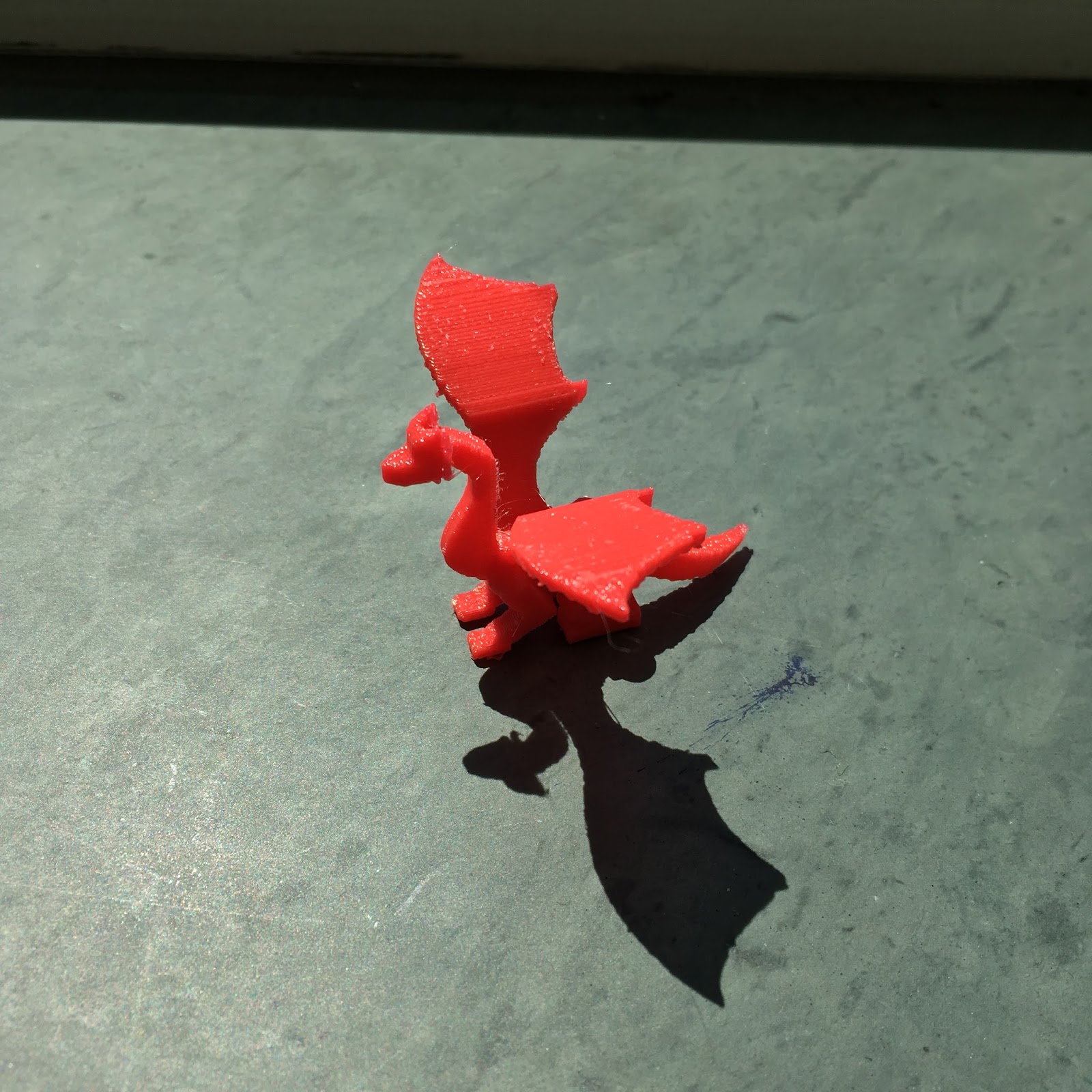
The only requirements for the game piece was that it had to have at least one quadratic, at least one circle and at least one changing dimension (like the cone).  The results were varied and excellent.  Some students were pretty literal and made actual game pieces, with appropriate detail.  Some were abstract, and others were representational.  Particularly impressive was Jake's dragon, which used around 200 inequalities, including lines, parabolas, circles, spheres and a very cool third-degree polynomial neck.  (Photos of a sampling the student work are below.)

Once again, I heard all the good classroom sounds, particularly frustration turned through persistence into joy.  Music to my ears.

Next year, I will rearrange some things so that we can be more creative in our "changing radius" possibilities.  I'm considering, too, adding in some parametric graphing which will open up new possibilities as well.  That's another thing on my list to think about this summer.


Monday, April 9, 2018

9^(1/2) isn't Purple - The Value of Wrong Answers

Last week, as I was getting ready to introduce rational exponents to my honors Algebra II classes, for some reason I flashed on a session offered by Ed Burger at last year's NCTM conference.  He spoke to the importance of productive failure - practicing being wrong and recovering.  He talked about asking kids to give him answers that they knew were wrong and how learning would follow.

So, I gave it a try.  The question I posed was, "What does 9^(1/2) mean?"  Their job was to give me either a correct answer and reason why it was correct, or a wrong answer and a reason why it was wrong.

I asked first for the wrong answers and reasons.

Student 1: "It's not purple."
Me:  "Why not?"
Student 1:  "Because the answer is a number."

Back in my early teaching days, I probably would have been irritated by that answer.  Experience, however, allowed me to see that even though there's a wise-crack element to the response, at its heart is real truth -- the answer is a number!  And the student is engaged!

Me:  "Okay, that's good.  So we've narrowed the answer down to a number.  Give me another wrong answer and why it's wrong."
Student 2: "It can't be 70 million."
Me:  "Okay, why not?"
S2: "It's way too big."
Me:  "But why 70 million?"
S2:  "Alright, 30,000.  Or 500.  It just can't be bigger than 9."

Bingo.  Had I asked the question "what is this?" I don't believe the student would have seen this fact.  By asking "what isn't this?" the student found it on his own.

Student 3:  "It has to be bigger than one, because 9^0 is one."

Student 4:  "It can't be 4.5, because it's not multiplication."

This was my favorite moment, because I know that if I had asked them right away what they thought 9^1/2 was, many of them would have said 4.5 for lack of a better answer, even if a little reflection would have told them that it was wrong.  By approaching the question from the negative, it forced them to reflect and it made that wrong answer a correct answer.

The conversation continued as we narrowed down the possibilities -- it probably was closer to 1 than it was to 9 because that's the pattern we saw with higher integer powers.

Eventually, I asked for a correct answer.  Some students knew what it was, but it took a little prompting from me for them to see the why.  I also helped them see that we were really "defining" rather than "figuring out."

Approaching an idea through wrong answers was effective for every student in the room.  The students who had been taught the right answer in another class were challenged with explaining why.  Some of them chose to find wrong answers with an explanation because it was easier.  For student who didn't know what the answer was, the entry bar was low -- there are a lot of wrong answers, yet they ended up making critical contributions to the discussion.  In the end, I believe everyone had a better understanding of the idea than they would have had I just allowed those who knew to tell those who didn't what the answer was.

Plus, it was way more fun this way. 


Wednesday, April 4, 2018

Travel to Ghana

For the past several years, my school has been part of a program based in Ghana called Right to Dream.  We've taken several students from the program who attend our school and then go on to US colleges.  They are true scholar-athletes, outstanding soccer players with tremendous drive and dedication in the classroom.

This summer, I am travelling with my wife and a group of students to visit the Right to Dream Academy in Ghana, where the students train and learn in preparation for their move to the States.  We will be doing some service learning while we're there, and among other things we'll be visiting a local school where the Academy students volunteer, as their own way of giving back.

I've been tasked with bringing some "math manipulatives or equipment" with me to leave at the school we're visiting.  It's a lower and middle school, and I am a high school teacher.

So:  Help!  I don't have much more information other than the school has very little.  What would you bring?  I'm sure that a few decks of Set are a good idea.  What else?  Any help would be mighty much appreciated.  

Thanks!


Monday, October 16, 2017

3-D Printing in My Classroom -- Project #1

Background

Our story begins one day two years ago when I wandered by our tech office and noticed that there were a couple of 3-D printers sitting on a table.  They had been donated to the school, but it wasn't clear how we were going to use them.  "Hmmmm," I thought.

I knew that I could find a use for them in my classroom, but I wanted it to support and extend what I was doing, rather than simply be a cool thing I was using -- there needed to be mathematical substance.  After some investigation, I decided that the right tool was Mathematica.  If the goal was to design 3D objects to print, it would make sense to use one of the CAD programs that would allow students to simply draw lines and circles by clicking and dragging.  Mathematica demanded that they have equations for every line and curve they use.

The school was kind enough to purchase me a copy of Mathematica so I could figure out how to use it.  So I spent the summer of 2016 playing with the program and the printer.  At first I spent a lot of time with calculus ideas, in particular printing solids of known cross-section. Much of my time was spent making a 3-D "Match the Solid" activity for AP Calculus.  The result was cool and different, but I'm not sure it was worth the time that it took.  Unless you factor in the fun I had -- then it was totally worth it.


The next step was to do something with students.  I decided that my Algebra 2 - Honors class was a fine set of guinea pigs.  For some reason, I've always been intrigued by magnets, especially those little powerful ones that can hold up a hammer and such.  I purchased a bunch of small ones, and the project that I had my class do was to make a refrigerator magnet based on an original 3-D design.  (It's a school assignment that was built to go on the refrigerator!  How meta.)

Some of the magnet projects
I only had the one copy of Mathematica, so I showed my class how the coding worked, and had them write the code in a word processor and then e-mail it to me.  There was a little awkwardness to this, but it did require them to really focus on their equations and with Desmos as a tool, it didn't hinder them too much.  It also removed the technical "missed comma" type of error from their experience.  The downside, of course, is that my experience was all about missed commas and such.  Still, it worked out well.  Some students sat at my computer to tinker with their equations, and all were able to produce something they were proud of.  Some designs were relatively simple, using mostly lines; others were more complicated, involving circles that changed radius depending on the z-coordinate (see the Christmas tree).  It was a good review of lines, absolute value functions, circles and parabolas.  The students were proud of their work, and had something tangible to take from it.
Our chess set in action.

A cat.  Notice the trig tail.
Later in the year I decided to do a second trial run with my AP Calculus class.  In that awkward period after the exam and before graduation (about 3 weeks at our school), I had my students download a 10-day trial of Mathematica.  When I explained what we were going to do, one of the students suggested that we make a chess set.  The students divided up the pieces, and went to work.  You can see the rendered pieces in the columns on the sides of this blog.  The printed pieces live in the lobby of our schoolhouse.

I had the good fortune of sitting in on one of Professor David Bachmann's classes at Pitzer College last March.  He was using Mathematica to have students explore parametric equations, and introduced me to a book that any math/foodie should have -- Pasta By Design.  I showed this to my class this year, and one student said that he is glad to live in a world where a book like this exists.


After doing these projects last year, I wanted my Algebra 2 students to have access to Mathematica.  Research and some negotiation with Wolfram landed on a price of about $2000 per year for enough licenses for my students.  Ouch.  I'm fortunate to work at a school with the resources to support these kinds of things, and my proposal to our business manager was approved.

Project #1

I decided to start simple.  We typically do a review of graphing lines at the start of the year, so I integrated that unit with an introduction to Mathematica.

We began on Desmos, and students were asked to draw a square using a set of inequalities.  Then we moved into Mathematica, where I showed them how to use the function we'll be using most:  RegionPlot3D.  Student plotted the same equations from the Desmos square into Mathematica, and saw that it created a square-based box that went from one end of their window to the other.  In order to make a cube, we needed to add restrictions to the z-axis.  I showed them how to make a second object using the "or" command (|| in Mathematica), and then they were on their own to complete five challenge objects that I'd created (an approach I saw Professor Bachman use.) 

It was then that I knew I was onto something good.  I started to hear things that I love to hear in the classroom:
"Aaaargh!" followed by "I got it!!"
An involuntary "Yesssss!!"
"I did it! I did it!" 
Student to another student:  "Help me!"
And so on.

I loved the instant non-judgemental feedback that technology can offer -- "Why is my object not there?"  (Experienced teacher guess:  "You have one of your inequalities going in the wrong direction.")  Some students were more frustrated that I would have liked, but they all found a way out of the woods and were ultimately successful, even if they didn't get through all five objects.  Their homework assignment was to make an object with only boxes. 

A few days later, as the last question on a quiz on equations of lines, I asked them to determine what the following equations would produce if graphed in three dimensions:

y < x + 5, y < -x + 5, y < z + 5, y < -z + 5, y > 0.

About half of them figured it out, and others were close.  After the quiz, I gave them an information sheet on the Great Pyramid of Giza and challenged them to render it in 3D.  A few students were able to complete the pyramid (more shouts of "I did it!"), but there wasn't time in the period for everyone to get there.  We did talk about it at the start of the next class, but we needed to move on to other (non 3-D) things.

Now it was time for project #1:   Make an object using lines.
Your object should:
1)  Use only linear equations
2)  Use equations in all three directions (x, y and z), beyond just adding "thickness" or "length"
3)  Have at least two parts connected by an "or" (||) in your code.
4)  Have comments in the code, including indications of what each part of the code describes.  (*comment*)

 I also gave them a grading rubric for the project.

Creative projects always create a dilemma for me.  There are always some students that will create something remarkable, but this can be a mixed blessing for the group.  Seeing someone else's excellent work can inspire or discourage, and it's sometimes a fine line between the two.  So I tried to keep expectations reasonable when I spoke about the project, knowing that my goal was to get each student to push themselves to do something great, and that the results might vary from student to student.

The x-wing code.
I gave them two weeks to do the project, which was plenty of time.  About four days after I gave the assignment, I received my first submission:  an X-wing fighter.  It looked awesome, used close to 70 equations (all lines), utilized the NOT function that I'd mentioned briefly in class, and demonstrated real passion and persistence on the part of the student.  As pleased and excited as I was, I chose not to print the X-wing until the other projects were finished, so as to limit the intimidation factor.

As students continued to work and completed their projects, I heard more of those things you love to hear:
"I made this!"
"I'm really proud of this!"
"I could have done even more."

The printed results looked great, and the students were excited to be able to hold their creations and to see what everyone else had done.

A sampling:
A man.

A chair.

A ping-pong table.


An "N".
A star.


A house.
The porch on the back of the house.


Initials.

 
Conclusion and Future Adjustments

Simply:  This is good stuff.  Students were challenged by the task and lived up to the challenge.  The task was open-ended enough that it had room for a chair and an x-wing fighter.  It was a good review of the graphing of lines.  There was also some friendly and quiet competitiveness that had some students realizing that they could have done more.  I hope this will carry over into the next project.

Some future adjustments:

1) My initial challenge objects need to be more interesting.

2)  I want to make sure every student gets through the pyramid rendering -- in retrospect, it would have been valuable practice.  I had also planned to follow up with having students render the Washington Monument from the dimensions of the monument.  This would have been useful too.

3)  Next time, I will emphasize and have students practice the NOT command.  (This allowed for the windows in the building, for example.)  This will add to the creativity and also add some good logical challenges to the process.

4)  Next time, I will require at least one set of perpendicular lines that are not horizontal-vertical.  This would be good practice for that skill.  I thought of this when the student who made the desk told me that he was thinking of putting a notebook at a diagonal on the top of the desk, but he ran out of time.

5)  I wonder if there's value in narrowing the assignment somewhat.  Since many students did furniture, one student suggested that we make a class IKEA-type catalog.  Another student suggested a hanging mobile with all the objects.  I had initially considered creating a small village, which would allow for buildings, vehicles, etc.

Next Projects

As we move into quadratics and other conics, the possibility for even more interesting designs increases.  A few possibilities:

1)  Refrigerator magnets.

2)  Make a game piece that you can use during our unit on probability.  (I also think I'd like to create a culture where people carry their own game pieces with them.  For example, you're at a friend's house and you're going to play Monopoly.  "Do you want to be the hat?" she asks.  "Don't worry, I've got it covered," you replay as you pull out your own personally designed token.  I'm sorry I didn't think of this when my children were little.  I would have raised them differently.)

3)  Design an animal head and/or body.  Print them separately, and then we can mix-and-match among the class (with carefully placed magnets in the neck area.)  Cool.

4)  It occurred to me that we could learn how to (for example) change the radius of a circle depending on the z-coordinate using sliders in Desmos.  Extending that, can you do the same with an equilateral triangle?  What about a star?


The Bottom Line
So far, so good.  The students are engaged, they feel like they are doing something new, unusual, challenging and accessible.  My job is to keep it that way.

If you've read this far, thanks!  Please offer any suggestions you've got.