I had a bonus long block period (85 minutes) with one of my Algebra II - Honors sections this week. The other section lost their long block due to the holiday. So, I decided to have them work with Conway's Rational Tangles. I won't re-invent the re-explaining wheel here, but I will point you to some links.
I first saw this through a YouTube video by Tom Davis. I adapted it to my classroom and I've done the activity four or five times with different groups of students.
After my first day at Twitter Math Camp this summer, I was back in my hotel room thinking about how I was surrounded by amazing educators, and it occurred to me that I'd be a fool not to ask questions when I had the opportunity. I remembered the Tangles activity, and how there were some pieces that hadn't ever quite worked. I figured somebody in Cleveland with me had written something about this, so I set to Google and --- BAM! -- there's a great article by Amie Albrecht describing the activity and reflecting on her own experience with it. (This is where you should start if you haven't seen the activity before.)
In a moment that sums up the joy of TMC, Amie was waiting for the bus the next morning when I walked outside the hotel. I accosted her with my questions, and so as we walked to find some food, she told me about her experience with the activity.
The most interesting thing Amie added to the activity was a Notice-and-Wonder exercise that allowed students to at least try to discover the rules of the activity themselves.
Which brings me (at last!) to my experience on this round.
I began by showing Amie's "Notice and Wonder" video. It's a sped-up video of students doing the final Tangles exercise. Students noticed and wondered the same sorts of things Amie's students did: They only seem to rotate in one direction, sometimes two of the students switch places, what's the deal with the bag, etc. The video was an addition to my usual presentation of the problem, and I liked it. It engaged students in the exercise right away, and made them curious immediately. I liked too that they were seeing other students in another classroom doing what they were about to do.
Next, I clarified the rules they had noticed to them -- we rotate clockwise, and can only "twist" from two positions in one direction. I had four students demonstrate with our ropes, following my commands and creating a tangle.
Then I made a careless error in my approach. I had divided them into two groups, and I was going to send them off to figure out how to untangle a tangle formed by a series of twists -- how would you untangle one twist? Two twists? Three twists? And so on. To make myself clear, I carelessly wrote "T", "TT" and "TTT" to demonstrate what I meant. Here's why that's a mistake: one of the things I love about this exercise is that it starts out in a very tangible and physical way -- ropes are being tangled. However, to keep track of what's going on as you try to solve the problems, it becomes necessary to come up with an abstract way of expressing what's being done. In the past students have written out the words "Twist" and "Rotate", used arrows to indicate that one follows the other, and made up other sensible but cumbersome methods of recording their progress. Eventually, they settle on the simple string of R's and T's. I think it's valuable for them to have that experience because it mimics a lot of what mathematical notation does -- it takes a complicated situation and makes it simpler to express.
And I robbed them of this part of the exercise, because I was distracted by difficulties with the projector and my hurry to get to the project. Dang.
So, I sent them off to solve the Problem of the Twisted Tangles. I wandered between groups, and I was pleased that they each solved the problem in about 15 minutes. What I love about this part of the process is that they discover that to undo a T, they do an RT. To undo a TT, they guess it will be RTRT, only to discover that they need an extra T. Finally, they guess that to undo a TTT, it'll be RTRTTRTTT. When they try this, they discover that they've untangled it without that last T. Then they feel confident that to untangle TTTT it will be RTRTTRTTRTT. And it is. The solution kind of finds itself.
We returned to the classroom, and summarized what they'd found. A student wrote on the board:
T = RT
TT=RTRTT
TTT=RTRTTRTT
TTTT=RTRTTRTTRTT
I should have advised against the use of the equal sign here, as it implies something else, but I let it go. (It was a source of confusion later, so I regret that decision not to nip it in the bud.)
I had students stand with the rope, and we talked about something one of the groups had discovered -- it never makes sense to do two rotates in a row. I demonstrated with a couple of different tangles.
Next, I had them make a TTTRT tangle to see if they could undo it. They struggled a bit until someone realized that it was the TTT pattern starting to untangle. Then they could just read the solution of the board.
I made up a tangle that they couldn't solve the same way -- something like TTTTRTTTRT. We'd need another method.
At some point, a student had referred to the starting position as "a nothing tangle." I suggested that we follow this and give it a number. The consensus was that 0 made sense for the starting state. Then we needed to decide what a Twist does to the number -- several suggested that it should add 1 to the value of the tangle.
At this point, I paused to give them a moment to see that since we were defining both the starting point's value (zero) and the role of a twist (+1), there was no "wrong" way to choose a value or an operation. We could choose the starting tangle to be a 7, and a twist to be a "multiply by 5." Of course, this would likely make the overall solution of the problem unduly complicated, so it makes sense to keep things simple. (I'm pretty sure that it would be solvable with these first conditions, but not certain.)
Now the tricky part: What does a Rotation do?
We looked at tangles that we knew how to solve:
TRT would be 0, then 1, then x, then 0. But the final zero gives us x+1=0, so x must be -1.
Which means that R gets us from 1 to -1.
Perhaps R is "subtract 2"? But then TTR would be a zero tangle, and it clearly isn't. Hmmm.
Perhaps R is "multiply by -1". Then TTRTT would be a zero tangle. And it isn't.
Double hmmm.
After some quiet struggle, I had the students start with a zero tangle, and do a rotate. The question is: What number do we have here?
I tell them to do a twist. What happens? Nothing changes. Which means the number must be a solution to the equation x + 1 = x. Hmm. At this point in the past, I've had a student recognize that x might be infinity. No such luck this year.
What number plus 1 equals itself? I gave students the hint: "Think of a playground taunt." Sometimes this is enough -- not this year. I give them enough coaxing to get: "I hate you infinity," and the retort: "I hate you infinity plus one." They see what I'm getting at, and they also wonder aloud if I had a difficult childhood. (Not so much, but I probably need a more positive prompt.)
Anyway, once they see that infinity fits the bill, the question becomes: What operation can we perform on the number 1 that will bring us from 0 to infinity and then back to 0? They puzzle and guess some things, but eventually someone suggests dividing by 0. This leads to someone else suggesting that taking the reciprocal will do it. They piece together that it's the negative reciprocal, and we're off to the races.
As you can tell, I haven't figured out a slick way of having students discover the rotation operation. They'll look at some tangles and makes some algebraic equations, but it's different when the operation is the variable instead of the number. It seems like relying on insight and instinct (and hints from the teacher) is the only way to go.
We tested our hypotheses (T is "add one", R is "take the negative reciprocal") on some of the tangles we'd solved. Then, for homework, I gave them a more difficult tangle to undo. We calculated that the value of the knot was 14/8.
They returned the next day with some success, and enough agreement on a solution for us to try it out. We made the original tangle. Then I inserted each of the four ropes through a plastic bag. We then followed the "untangle" steps which created a tangle of rope and plastic.
The big payoff: as students stood in their spots holding the ropes, I tore away the plastic bag and - TADA! - an untangled rope.
My (continuing to develop) conclusion: This is a good exercise for this type of situation, and a class of about 12. My class of 16 meant I should have probably had a third group, but I was lacking both ropes and space to do so. With 8 in a group, it was possible for students to be disengaged, or to have their ideas lost in the ruckus of a larger group.
I also find that it's easy to think that the four students actually holding the ropes are engaged, but sometimes they are just following directions and not really thinking.
I continue to have trouble getting someone to discover the rule for rotations. The project is always more satisfying (for me and for the students) when a student has the "negative reciprocal" insight.
Still: I like this activity a lot. It's different, it's accessible, and it has a nice concluding moment, worthy of cheering. It also has some sophisticated extension questions (Can you make any rational number into a knot? Can any rational number be untangled?), although I must admit I haven't had students pursue these in the past.
For sure, I'll do it again.
Tuesday, January 1, 2019

Wednesday, September 5, 2018
First Day of Calculus
In two days, I begin my 36th year teaching, and probably my 25th year teaching AP calculus. So of course, I figured I'd try something different.
Usually I've tried to give the course some context -- we're going to find slope at a point and area under a curve: here's why we care. Last year, I built a given-the-velocity-find-the-distance activity. It was okay, and I'll probably use a revised version of it at some point in the year. (I've already videoed the speedometer on my new e-bike in preparation.)
This year, I'm going to jump right into limits. Here's may plan for the first two days or so.
Day 1 (30 minutes): First thing, a Which One Doesn't Belong (word doc link):

*As a side-note, I keep waiting for a time when I don't look back 8 or 10 years and think, "Holy cow -- I had no idea what I was doing back then." So I'm assuming Sam and Dave have moved on to something that they feel is progress, while progress for me is moving into someone else's past. My past is open for occupancy. If only I'd blogged back then.
Usually I've tried to give the course some context -- we're going to find slope at a point and area under a curve: here's why we care. Last year, I built a given-the-velocity-find-the-distance activity. It was okay, and I'll probably use a revised version of it at some point in the year. (I've already videoed the speedometer on my new e-bike in preparation.)
This year, I'm going to jump right into limits. Here's may plan for the first two days or so.
Day 1 (30 minutes): First thing, a Which One Doesn't Belong (word doc link):

Since most (all?) of the students will not have done a WODB before, I suspect that (D) will be the overwhelming selection as the "right" answer. I'll need to use my sneaky teacher skills to get them to start looking elsewhere as well. No sweat.
Next, we'll do a Desmos Polygraph I made that will (I hope!) force them to start reaching for vocabulary they don't yet have. ("Teach us the right words!" they'll demand, "Teach us! Pleeeeeeease!")
That will likely finish the 30 minutes. It will feel half-done, but that's okay.
For homework, inspired by CalcDave's 8-year-old* (!) blog post, discovered via Sam Shah's also 8-year-old blog post, I've made a questionnaire of my own. I added a little more algebra to mine, and a little less get-to-know-you. (I've taught the majority of my students before, and I know most of the rest from other things.) I do need to test their mettle, so to speak, as I'd like to determine whether the AP pace and demands will work for them moving forward.
Day 2 will be a couple of Speed Dating exercises. We'll do the first one without hardly any guidance from me as to what a limit is. I will tell them how to read the statement ("the limit as x approaches 2 of f(x)") and make that part of the exercise, so that they get used to the language. Other than that, the'll need to figure out where the right answers come from. This is what I've taken from the #MTBoS philosophy: don't tell students anything.
After that's run its course, we'll regroup as a class and I'll answer any questions they have. Once that happens, we'll do the second speed dating exercise, this time (if all goes right) with a bit more comfort and success. Homework will be practicing limits by graphing, and then we can get into algebraic limits on day three.
And we're off..
*As a side-note, I keep waiting for a time when I don't look back 8 or 10 years and think, "Holy cow -- I had no idea what I was doing back then." So I'm assuming Sam and Dave have moved on to something that they feel is progress, while progress for me is moving into someone else's past. My past is open for occupancy. If only I'd blogged back then.
Sunday, August 5, 2018
Twitter Before Breakfast
I'd like to say that Twitter has become a daily presence in my life. But it's much worse than that. Okay, that's society talking. I think it's better. Here's what Twitter had me thinking about this morning - a Sunday morning in the summer -- from 8:03 to 8:21.
8:03. A tweet from Amie Albrecht, now the Australian who inserts her presence in my day more than any other, as she has now surpassed Courtney Barnett.

I always gave this exact answer when I was a kid and people asked why I liked math. As I've continued to grow and learn, I realize that math is all about the journey and less about the destination, but I do find it comforting that there is a "truth" at the end that we can all agree on, even if that truth is that the truth is unknowable. I can prove that root 2 is irrational, I can demonstrate that infinite sets have different cardinalities, I can prove the Pythagoream 40 different ways. (Don't challenge me on that last one.) Proofs are sometimes sensible, sometimes highly counter-intuitive, and sometimes incomprehensible to me (see: Fermat). Yet, without a "right" answer at the end, the whole beautiful exercise could end in murky conclusions like a debate in economics or even science. Those debates are obviously important, but I enjoy the comfort of knowing that an absolute (albeit abstract) truth exists out there.
There's a good discussion in this tweet's thread.
8:06. Another one from Amie. I was planning to do the Quarter the Cross exercise on the first day of geometry, and here's Amie adding another dimension - a card sort! Check it out. Thanks, Amie!

8:08. Again from Amie. (Not really a surprise -- she's tweeting while we're all sleeping.) It's really a link to Fawn Nguyen's blog post about using different colored highlighters to mark student work. I've seen this before and liked it, so I added it to a Wakelet folder (probably for the third time.)

8:09. Andre Sasser asks about getting permission from students to post their photos. I've been wondering about this, and also how to blog honestly about the specifics of what's happening in a classroom without running the risk of embarrassing my students should they read what I've written. I'll always try to make sure I'm communicating fondness and positivity toward my students, but I can't control how they interpret what I've written.

8:11. I don't follow this account, but it shows up via likes every so often and I like it. I like how the post begins: "I pet Sadie." I picture the build-up to this like the lunar module landing on the moon: "I am approaching Sadie. All systems are go. 10 feet. Tail is wagging. 5 feet. Tongue is drooling. Houston, we have contact."

8:12. Math photo scale week. I am reminded of my candy loving (now 23-year-old) daughter, thinking I'd be almost certain to take this same photo when she were younger. I had also seen one of these crazy machines at the movie theater last night, so I was thinking about my daughter and candy.
Also, I want to take some #MathPhoto18 pics, but I keep forgetting to check the theme.

8:14. Somebody saw "GOD" in a sliced eggplant. Good ol' Twitter.

8:15. Back to Andre with a grocery bag suggestion.

This had more meaning to me that I expected. For the past three years, we've had two girls from Ghana at Millbrook, one of whom has lived with us. They were back in Ghana this summer for the first time in three years, and they return this very day. I'll be glad to see them, in part because they are literally my supermarket adventure partners. Here's what it's like to shop with them:

I guess I gotta buy that shopping bag.
8:17. A reminder about EquatIO. I haven't really figured out how this will work for me, but it's on my list to look into this summer. Getting late, though.

Then, in yet another fortuitous coincidence, when I went to log on to my computer to write this, Windows had a message for me:

EquaIO wants to "Read and change all your data on the websites I visit." Uh, no. I don't even give myself permission to do that. I'll check on it later...
[Note: I checked it out, Accepted Permissions and I'm really excited to use EquatiO this year.]
8:21. A retweet from Blank Panther Girl.

I've been thinking about this a lot this summer, without reaching any coherent chain of thought. It began with our trip to Ghana, where we met wonderful people and saw a country that had robbed of its resources, both physical and human, for hundreds of years before this century, largely to the benefit of people like me. We got to meet our two Ghanaian girls' families, which was emotional beyond explanation. The students who were with us worked with a school on some math, some storytelling and some soccer. I know the school appreciated what we did, but it's hard to know how to feel. This photo below of the class playing SET sums it up -- it makes me proud, confused, sad and happy all at once.

Marian Dingle's keynote at TMC18 (watch, read) gave me further reason to reflect and even less clarity (in a good way!). I also thought about my experience with our two Ghana girls, and how it's offered me the opportunity (if that's the right word) to see the pervasive, yet often very subtle, nature of the racism that exists in my world.
And that's a heavy note to end on, but that's about 20 minutes of my Twitter experience. In the middle of the summer. All before breakfast.
Thursday, July 26, 2018
I'm Just Like Them!
I've had the experience of meeting in person people I'd admired from afar, and almost always my response has been, "Hey! They're just like me!" My experience last week was even better. After meeting all the amazing people at TMC18 last week all I could think was, "Hey! I'm just like them!"
As I've put off writing down my reflections on the TMC experience, that conclusion has only been reinforced as I've read blog after blog after blog that seemed to be reading my mind.
After returning to my room after game night, I did something pretty uncharacteristic of me -- I made a list of all the people over the past few days with whom I'd had a substantive conversation. (It will come as no surprise to anyone who knows this group that this was pretty much anyone I spoke with.) I was shocked when my count reached 50. Fifty people! In three days! For this introverted guy! Wow.
I can point to a few things that made me super-comfortable very quickly:
As I've put off writing down my reflections on the TMC experience, that conclusion has only been reinforced as I've read blog after blog after blog that seemed to be reading my mind.
After returning to my room after game night, I did something pretty uncharacteristic of me -- I made a list of all the people over the past few days with whom I'd had a substantive conversation. (It will come as no surprise to anyone who knows this group that this was pretty much anyone I spoke with.) I was shocked when my count reached 50. Fifty people! In three days! For this introverted guy! Wow.
I can point to a few things that made me super-comfortable very quickly:
- Sam's Facebook post talking about his own anxiety about remembering people's names.
- Glenn's explicit permission for us to be by ourselves if that's what we needed, and his introvert joke. (How can you tell if a mathematician is an extrovert? They're looking at your shoes instead of their own.)
- Sam's introvert button.
- Everyone's aggressive openness, including meal invitations, and especially the open discussion of the "pac-man circle." It made it easy to do something that I've never been comfortable with -- just joining a group that's standing around. Wow again.
Other random thoughts:
The experience of reading other people's blogs where they shared their internal dialogue almost real-time was amazing. It was kind of like reading a novel with an omniscient third-person narrator. We all shared an experience, and then I could read about what other people were thinking -- always feeling a sense of camaraderie as I learned from each one.
Seeing so many people be publicly vulnerable, especially those who I saw as stalwarts of the #MTBoS community was amazing, touching, inspirational and empowering.
All of which was distilled in Julie's keynote. I don't have the adjectives to fully describe the experience, but if you were there, you understand. I'm thinking this could have been the most important hour for me in the past year. Wow.
I really appreciated the structure of the conference. It was really great to work with the same group for three days in the morning. The My Favorites were really wonderful, and I really appreciated the wide range of things people spoke about. I appreciated the decreasing lengths of sessions as the day went on and my energy waned.
Above all, I am grateful for the opportunity to have gotten to know so many amazing people. Over the past year, I've watched as someone will occasionally tweet, "What a bad day I had!" and 20 people will tweet back encouragement. I thought that was nice, but after having had the full TMC experience, I understand how meaningful that support really is. I hope that I can add my voice to that crowd of support when needed (and maybe even draw on it from time to time.)
Thanks everyone for welcoming this first-timer. It's an experience that I'll carry with me.
Sunday, April 22, 2018
3-D Printing -- Project #2
For our second 3-D design project, I had students make game tokens for games they were designing. They have been using systems of inequalities in 3-variables along with Mathematica to design and print 3-D objects. There are no shortcuts -- everything is defined by an equation.
I told them that one of my regrets as a parent is that I didn't have my children (who are now out of college) mathematically design and 3-D print their own game pieces that they could carry with them wherever they went. That way, while other kids could fight about who was going to be the race car and who had to be the thimble, my well-prepared children could pull out a personalized way-cool game token and say, "I'm good." Ah, opportunity lost.
We began by learning about the equations to circles, and I gave them some challenges to complete -- create a cylinder, intersecting cylinders, a cylinder with a hole, and the car-looking-thing below.


Most were successful pretty quickly, as they'd become used to thinking in more than just the x-y axis from our previous work in Mathematica.
The next set of challenges were more difficult. I had them think about how a cone and a cylinder are related. They could see that a cone is a cylinder whose radius changes as you move "up." That is, if the cylinder has its base in the x-y plane, the radius of the cone changes as z changes -- r is a function of z.
For example, if we want our cone to have a base radius of 5 and a height of 10, we take the inequality of the cylinder:
x^2 + y^2 < 5^2
and replace the radius (5) with a function of z. When z = 0, r = 5 and when z = 10, r = 0. We're really looking for the equation to the line between these two points, which is r = -1/2 z +5.
So, the new inequality for the cone is:
x^2 +y^2 < (-1/2 z + 5)^2
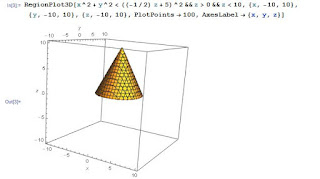


Again, many more paths to pursue. In particular, what would happen if both the x and y coordinates were functions of z? What if they were different functions, say a quadratic and a line? We're hinting toward parametric functions here and are also begging for periodic functions, neither of which we've covered yet. Maybe next year I'll rearrange things.
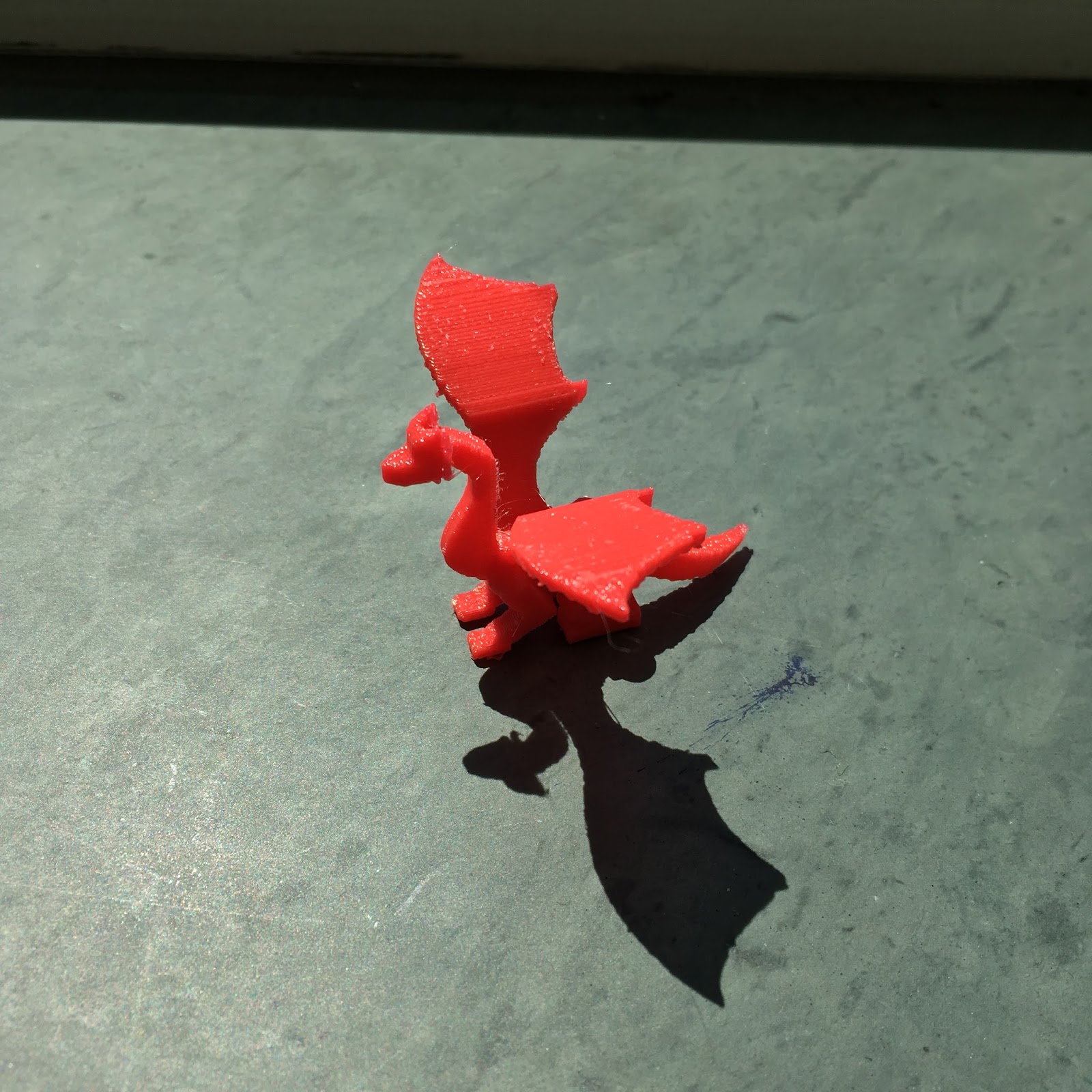
The only requirements for the game piece was that it had to have at least one quadratic, at least one circle and at least one changing dimension (like the cone). The results were varied and excellent. Some students were pretty literal and made actual game pieces, with appropriate detail. Some were abstract, and others were representational. Particularly impressive was Jake's dragon, which used around 200 inequalities, including lines, parabolas, circles, spheres and a very cool third-degree polynomial neck. (Photos of a sampling the student work are below.)
Once again, I heard all the good classroom sounds, particularly frustration turned through persistence into joy. Music to my ears.
Next year, I will rearrange some things so that we can be more creative in our "changing radius" possibilities. I'm considering, too, adding in some parametric graphing which will open up new possibilities as well. That's another thing on my list to think about this summer.


I told them that one of my regrets as a parent is that I didn't have my children (who are now out of college) mathematically design and 3-D print their own game pieces that they could carry with them wherever they went. That way, while other kids could fight about who was going to be the race car and who had to be the thimble, my well-prepared children could pull out a personalized way-cool game token and say, "I'm good." Ah, opportunity lost.
We began by learning about the equations to circles, and I gave them some challenges to complete -- create a cylinder, intersecting cylinders, a cylinder with a hole, and the car-looking-thing below.


Most were successful pretty quickly, as they'd become used to thinking in more than just the x-y axis from our previous work in Mathematica.
The next set of challenges were more difficult. I had them think about how a cone and a cylinder are related. They could see that a cone is a cylinder whose radius changes as you move "up." That is, if the cylinder has its base in the x-y plane, the radius of the cone changes as z changes -- r is a function of z.
For example, if we want our cone to have a base radius of 5 and a height of 10, we take the inequality of the cylinder:
x^2 + y^2 < 5^2
and replace the radius (5) with a function of z. When z = 0, r = 5 and when z = 10, r = 0. We're really looking for the equation to the line between these two points, which is r = -1/2 z +5.
So, the new inequality for the cone is:
x^2 +y^2 < (-1/2 z + 5)^2

Many mathematical tangents to talk about here.
- How would we write the equation to a cone with the relevant variables (Height, base radius, and center of base)?
- We've used composition of functions in a productive way.
- What if we wanted the sides to be a parabola, for example, or a Hershey's kiss? This would lead us to fitting quadratics and higher degree polynomials to data.
- How would we think of a (hemi-)sphere this same way, and develop the formula for a sphere?


Again, many more paths to pursue. In particular, what would happen if both the x and y coordinates were functions of z? What if they were different functions, say a quadratic and a line? We're hinting toward parametric functions here and are also begging for periodic functions, neither of which we've covered yet. Maybe next year I'll rearrange things.
The only requirements for the game piece was that it had to have at least one quadratic, at least one circle and at least one changing dimension (like the cone). The results were varied and excellent. Some students were pretty literal and made actual game pieces, with appropriate detail. Some were abstract, and others were representational. Particularly impressive was Jake's dragon, which used around 200 inequalities, including lines, parabolas, circles, spheres and a very cool third-degree polynomial neck. (Photos of a sampling the student work are below.)
Once again, I heard all the good classroom sounds, particularly frustration turned through persistence into joy. Music to my ears.
Next year, I will rearrange some things so that we can be more creative in our "changing radius" possibilities. I'm considering, too, adding in some parametric graphing which will open up new possibilities as well. That's another thing on my list to think about this summer.


Monday, April 9, 2018
9^(1/2) isn't Purple - The Value of Wrong Answers
Last week, as I was getting ready to introduce rational exponents to my honors Algebra II classes, for some reason I flashed on a session offered by Ed Burger at last year's NCTM conference. He spoke to the importance of productive failure - practicing being wrong and recovering. He talked about asking kids to give him answers that they knew were wrong and how learning would follow.
So, I gave it a try. The question I posed was, "What does 9^(1/2) mean?" Their job was to give me either a correct answer and reason why it was correct, or a wrong answer and a reason why it was wrong.
I asked first for the wrong answers and reasons.
Student 1: "It's not purple."
Me: "Why not?"
Student 1: "Because the answer is a number."
Back in my early teaching days, I probably would have been irritated by that answer. Experience, however, allowed me to see that even though there's a wise-crack element to the response, at its heart is real truth -- the answer is a number! And the student is engaged!
Me: "Okay, that's good. So we've narrowed the answer down to a number. Give me another wrong answer and why it's wrong."
Student 2: "It can't be 70 million."
Me: "Okay, why not?"
S2: "It's way too big."
Me: "But why 70 million?"
S2: "Alright, 30,000. Or 500. It just can't be bigger than 9."
Bingo. Had I asked the question "what is this?" I don't believe the student would have seen this fact. By asking "what isn't this?" the student found it on his own.
Student 3: "It has to be bigger than one, because 9^0 is one."
Student 4: "It can't be 4.5, because it's not multiplication."
This was my favorite moment, because I know that if I had asked them right away what they thought 9^1/2 was, many of them would have said 4.5 for lack of a better answer, even if a little reflection would have told them that it was wrong. By approaching the question from the negative, it forced them to reflect and it made that wrong answer a correct answer.
The conversation continued as we narrowed down the possibilities -- it probably was closer to 1 than it was to 9 because that's the pattern we saw with higher integer powers.
Eventually, I asked for a correct answer. Some students knew what it was, but it took a little prompting from me for them to see the why. I also helped them see that we were really "defining" rather than "figuring out."
Approaching an idea through wrong answers was effective for every student in the room. The students who had been taught the right answer in another class were challenged with explaining why. Some of them chose to find wrong answers with an explanation because it was easier. For student who didn't know what the answer was, the entry bar was low -- there are a lot of wrong answers, yet they ended up making critical contributions to the discussion. In the end, I believe everyone had a better understanding of the idea than they would have had I just allowed those who knew to tell those who didn't what the answer was.
Plus, it was way more fun this way.
So, I gave it a try. The question I posed was, "What does 9^(1/2) mean?" Their job was to give me either a correct answer and reason why it was correct, or a wrong answer and a reason why it was wrong.
I asked first for the wrong answers and reasons.
Student 1: "It's not purple."
Me: "Why not?"
Student 1: "Because the answer is a number."
Back in my early teaching days, I probably would have been irritated by that answer. Experience, however, allowed me to see that even though there's a wise-crack element to the response, at its heart is real truth -- the answer is a number! And the student is engaged!
Me: "Okay, that's good. So we've narrowed the answer down to a number. Give me another wrong answer and why it's wrong."
Student 2: "It can't be 70 million."
Me: "Okay, why not?"
S2: "It's way too big."
Me: "But why 70 million?"
S2: "Alright, 30,000. Or 500. It just can't be bigger than 9."
Bingo. Had I asked the question "what is this?" I don't believe the student would have seen this fact. By asking "what isn't this?" the student found it on his own.
Student 3: "It has to be bigger than one, because 9^0 is one."
Student 4: "It can't be 4.5, because it's not multiplication."
This was my favorite moment, because I know that if I had asked them right away what they thought 9^1/2 was, many of them would have said 4.5 for lack of a better answer, even if a little reflection would have told them that it was wrong. By approaching the question from the negative, it forced them to reflect and it made that wrong answer a correct answer.
The conversation continued as we narrowed down the possibilities -- it probably was closer to 1 than it was to 9 because that's the pattern we saw with higher integer powers.
Eventually, I asked for a correct answer. Some students knew what it was, but it took a little prompting from me for them to see the why. I also helped them see that we were really "defining" rather than "figuring out."
Approaching an idea through wrong answers was effective for every student in the room. The students who had been taught the right answer in another class were challenged with explaining why. Some of them chose to find wrong answers with an explanation because it was easier. For student who didn't know what the answer was, the entry bar was low -- there are a lot of wrong answers, yet they ended up making critical contributions to the discussion. In the end, I believe everyone had a better understanding of the idea than they would have had I just allowed those who knew to tell those who didn't what the answer was.
Plus, it was way more fun this way.
Wednesday, April 4, 2018
Travel to Ghana
For the past several years, my school has been part of a program based in Ghana called Right to Dream. We've taken several students from the program who attend our school and then go on to US colleges. They are true scholar-athletes, outstanding soccer players with tremendous drive and dedication in the classroom.
This summer, I am travelling with my wife and a group of students to visit the Right to Dream Academy in Ghana, where the students train and learn in preparation for their move to the States. We will be doing some service learning while we're there, and among other things we'll be visiting a local school where the Academy students volunteer, as their own way of giving back.
I've been tasked with bringing some "math manipulatives or equipment" with me to leave at the school we're visiting. It's a lower and middle school, and I am a high school teacher.
So: Help! I don't have much more information other than the school has very little. What would you bring? I'm sure that a few decks of Set are a good idea. What else? Any help would be mighty much appreciated.
Thanks!
Subscribe to:
Posts (Atom)